Operational Representations of Autonomous Execution
Execution State and Complementary Runtime Perspectives for Long-Running Autonomous Systems
Two autonomous executions may produce comparable runtime events while developing through fundamentally different execution progression.
Both perform similar retrieval operations, exhibit similar verification counts and consume comparable computational resources. One converges toward completion. The other repeatedly revisits earlier activity without structural development.
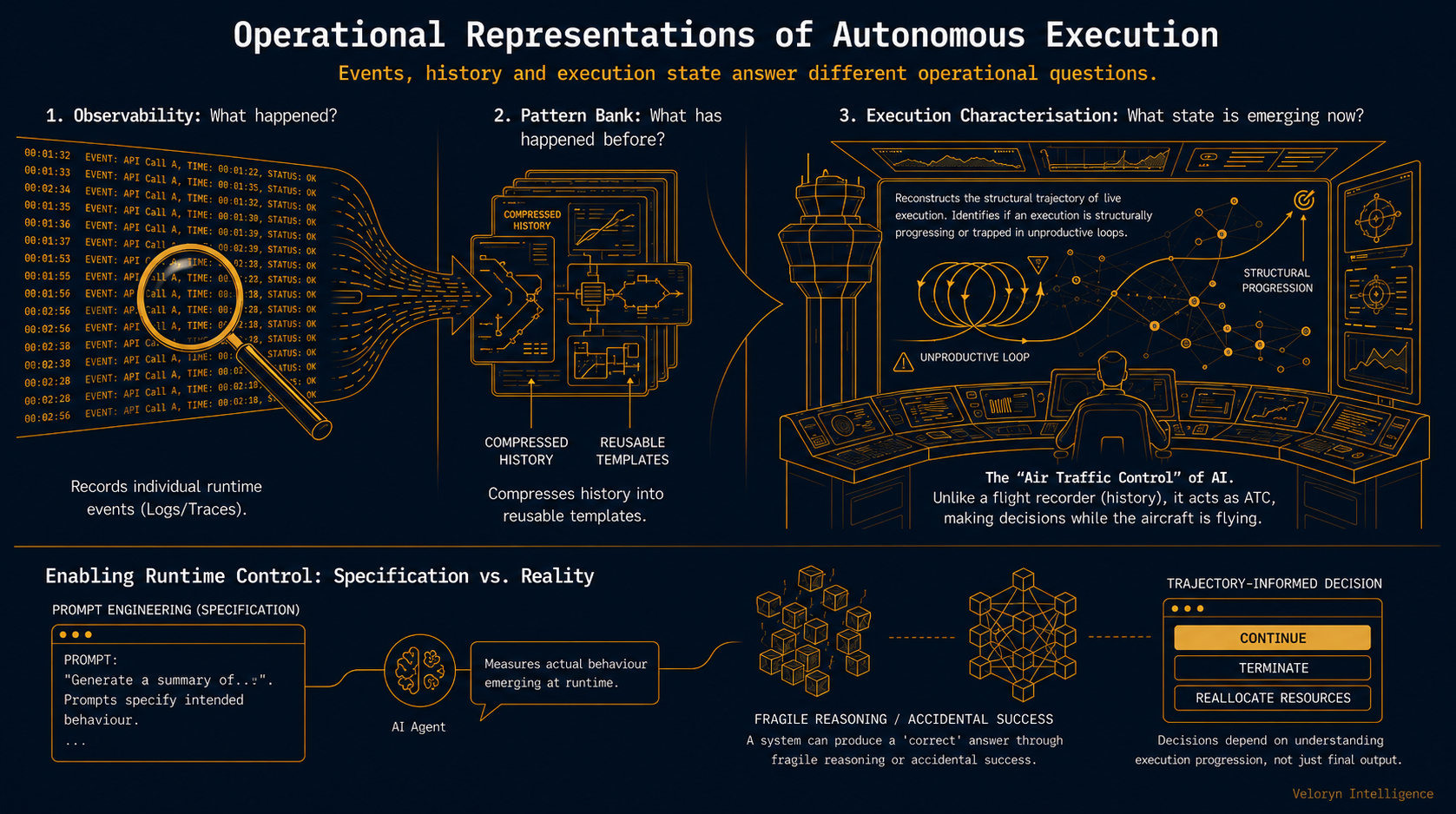
Existing operational infrastructure already provides representations of autonomous execution. Specification describes intended behavior. Coordination organizes execution across components. Observability records runtime events. Historical representations summarize previous execution. Semantic evaluation examines resulting outputs.
Long-running autonomous execution introduces an additional operational representation. Execution develops progression while it is still unfolding.
We refer to this operational representation as Execution State.
Operational Representations
Autonomous infrastructure relies upon multiple operational representations describing different aspects of execution rather than competing operational requirements.
| Operational Representation | Primary Question |
|---|---|
| Prompt Engineering | What should execute? |
| Workflow / Orchestration | How should execution be coordinated? |
| Observability | What happened? |
| Pattern Banks | What happened before? |
| Semantic Evaluation | Was the resulting output acceptable? |
| Execution State | What execution progression is emerging while execution is still unfolding? |
| Runtime Intervention | What intervention should occur? |
Each representation contributes a distinct operational perspective. Together they provide a broader understanding of autonomous execution than any individual representation alone.
Long-Running Autonomous Execution
Long-running autonomous execution develops through connected runtime progression extending across retrieval, verification, delegation, revision and evidence accumulation.
Existing operational representations reconstruct intended behavior, runtime events, historical similarity or resulting outputs.
None reconstructs execution progression as it develops across runtime.
Specification Is Not Observation
Specification defines intent; observation reconstructs progression.
Prompt engineering specifies intended behavior. Workflow orchestration specifies intended coordination. Observed execution develops through its own progression regardless.
These perspectives are complementary because they answer different operational questions.
Events Are Not State
Observability records runtime events. Execution progression develops across the relationships connecting those events rather than within any individual event.
Two executions may produce comparable event counts while exhibiting fundamentally different structural progression.
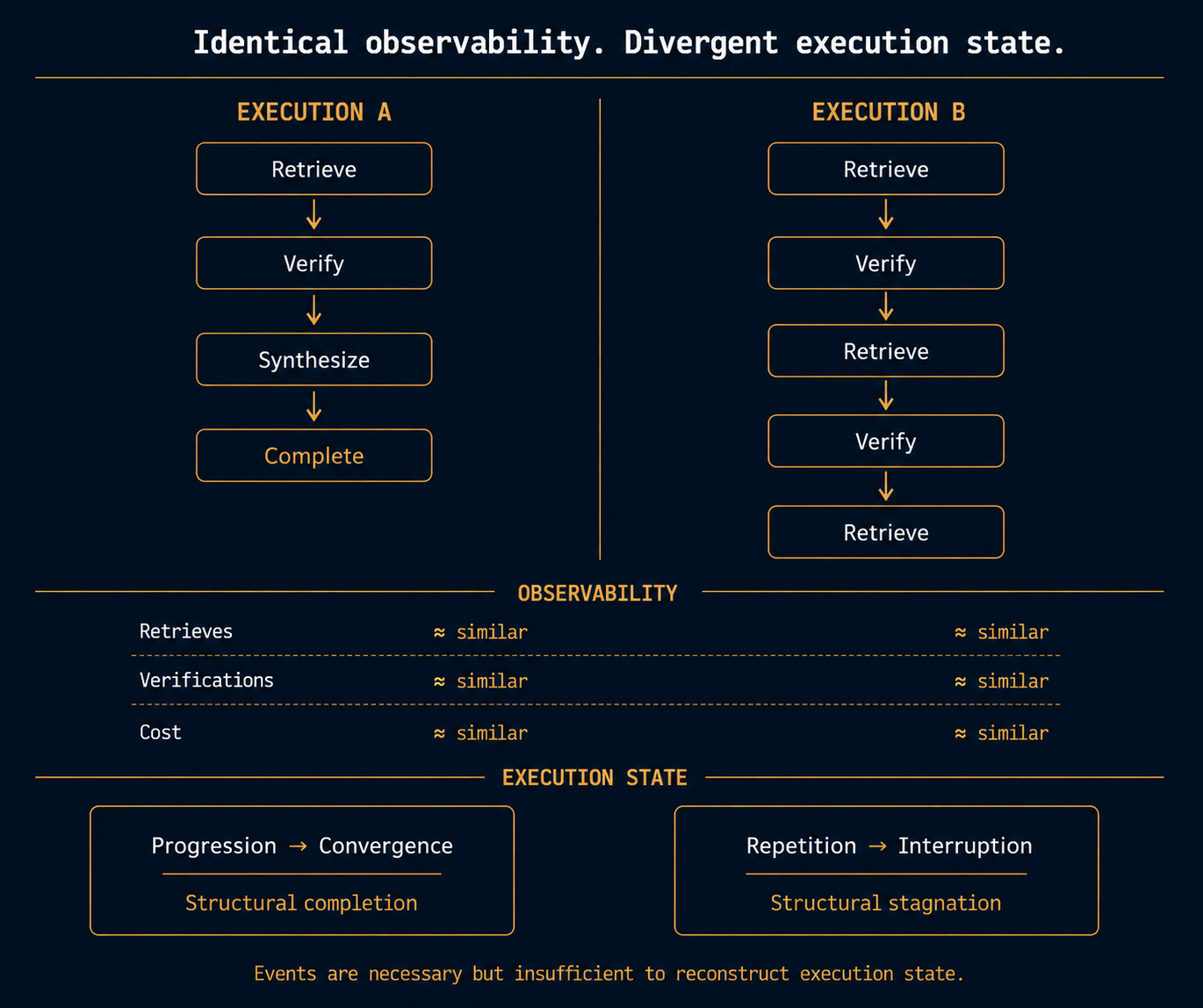
Comparable events do not imply comparable execution progression.
History Is Not State
Pattern banks summarize previously observed execution and provide reusable historical context.
Historical similarity informs expectation. Current execution progression informs understanding of the execution presently unfolding.
These representations describe different temporal perspectives: one reconstructs the past; the other tracks the present.
Outcome Is Not Progression
Semantic evaluation examines resulting outputs.
Execution progression develops before those outputs exist.
Correct outcomes may emerge from fragile execution. Comparable outcomes may emerge through substantially different progression.
Resulting outputs and execution progression are distinct operational representations.
Representative Runtime Structures
Representative runtime structures illustrate recurring patterns across execution progression. They build operational intuition rather than demonstrate implementation.
Retrieval-Dominant Progression
Observability reports healthy execution, acceptable latency and successful operations. Execution progression remains dominated by continued acquisition with no structural transition and no evidence accumulation.
Continued activity does not indicate continued progress.
Verification-Dominant Progression
Verification repeatedly interrupts progression.
No convergence develops.
Successful verification does not indicate execution progression.
Convergent Progression
Evidence accumulation, verification and revision collectively produce progressive stabilization before completion.
Convergence emerges across execution progression rather than within any individual runtime event.
Structurally Stagnant Progression
Healthy runtime metrics coexist with repeated structural motifs that introduce no additional execution development.
Healthy execution may exhibit structural stagnation.
Successful but Fragile Progression
Semantic evaluation produces an acceptable outcome. Execution exhibits continuous acquisition without synthesis or observable convergence.
Correct outcomes do not imply reliable execution progression.
Execution State
Long-running execution develops observable progression extending beyond isolated runtime events, historical patterns and resulting outputs.
Progression, continuation, interruption, evidence accumulation, delegation and convergence are observable throughout execution development, reflecting relationships across runtime rather than individual events.
Execution State represents what execution is emerging while it is still unfolding.
From Execution Progression to Execution State
Execution State is not a directly observable artifact. Unlike prompts, logs or outputs, it is inferred from relationships developing across execution progression.
Execution progression develops observable structural relationships across runtime.
Execution Characterisation reconstructs those relationships.
The resulting operational representation is referred to here as Execution State.
Together they provide a coherent representation of execution progression while it is still unfolding.
Operational Consequences
Long-running autonomous execution introduces operational questions that specification, coordination, runtime events, historical similarity and resulting outputs do not answer.
Execution progression can be examined independently of event frequency. Continuation can be understood independently of completion. Evidence accumulation is observable independently of resulting outputs. Verification participates in progression rather than functioning exclusively as terminal validation.
Execution State complements existing operational representations by describing what execution is becoming while it is still unfolding.
Closing Thesis
Execution progresses before it completes. Operational representations describe different aspects of that progression.
Execution State represents what execution is becoming while it is still unfolding.
Together these operational representations provide a broader understanding of long-running autonomous execution.