Enterprise Infrastructure Preserves Outcomes, Not Autonomous Execution
Enterprise infrastructure preserves documents, code, logs and data while autonomous execution remains transient.
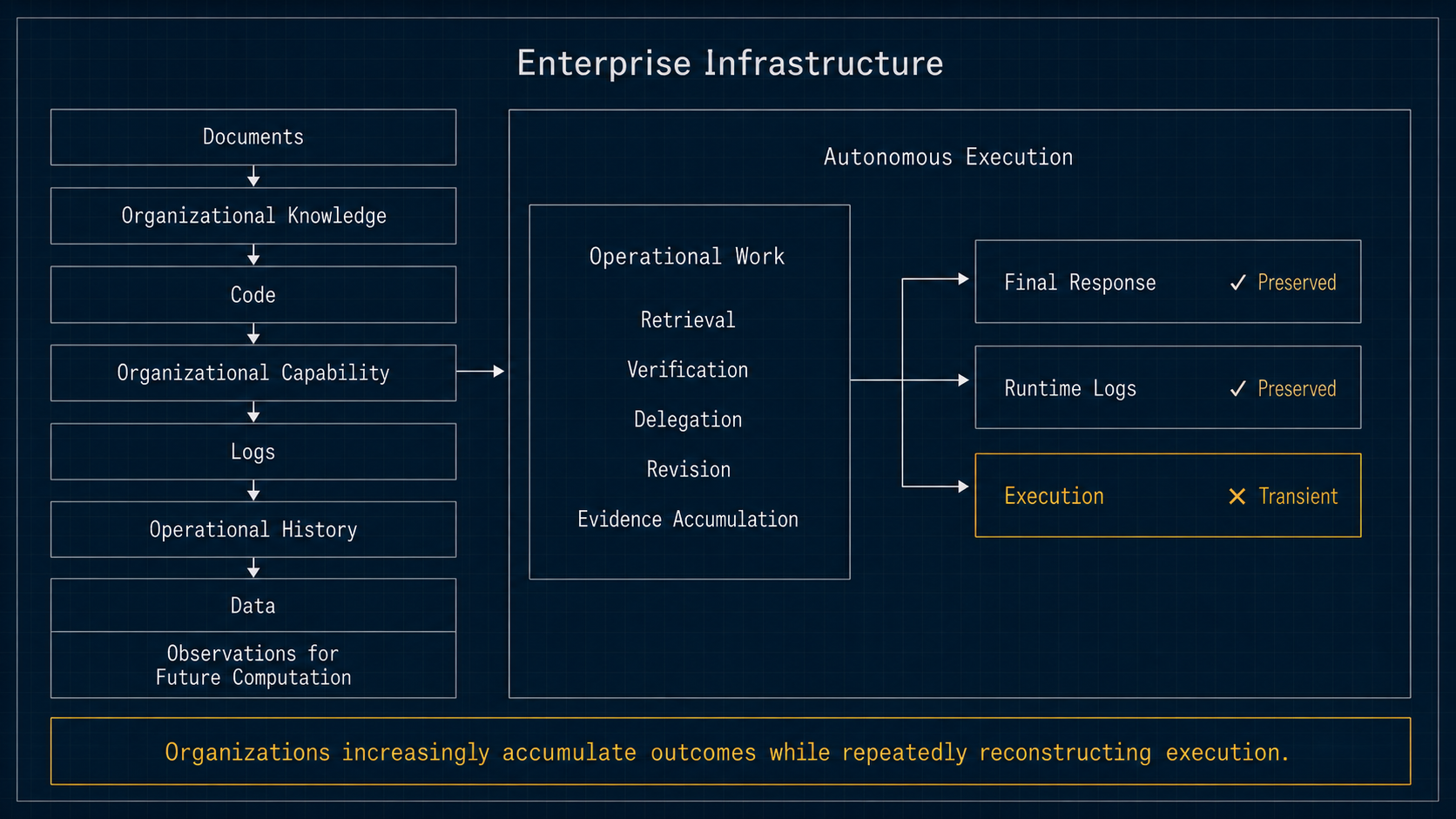
Enterprise infrastructure is fundamentally organized around persistent operational artifacts.
Documents preserve organizational knowledge.
Code preserves organizational capability.
Logs preserve operational history.
Data preserves observations for future computation.
Each persists beyond individual operational activity and compounds through accumulation, allowing organizations to build upon previous operational experience rather than repeatedly reconstructing it.
Autonomous systems increasingly perform a different kind of operational work.
They retrieve information, evaluate competing hypotheses, verify evidence, delegate subtasks, revise intermediate conclusions and progressively develop operational solutions.
Every execution produces operational experience.
Yet when execution completes, most enterprises retain only fragments of that experience.
The final response is preserved.
The logs may remain.
The execution itself disappears.
Reconstructing Operational Work
Consider an autonomous system investigating a production incident.
It explores multiple hypotheses, verifies dependencies, eliminates incorrect paths and progressively converges on the underlying cause.
The following day, a similar incident occurs.
The organization retrieves documentation.
It retrieves source code.
It retrieves historical tickets.
It retrieves dashboards and runtime logs.
The autonomous system nevertheless reconstructs much of the same operational work because the previous execution never became part of persistent enterprise infrastructure.
Operational experience existed.
It simply did not accumulate.
Organizations increasingly accumulate outcomes while repeatedly reconstructing execution.
Successful retrieval is rediscovered.
Verification strategies are reconstructed.
Evidence accumulation begins again.
Operational progression is rebuilt rather than reused.
Without persistent execution, enterprises retain the outcome while losing the operational experience that produced it, making reliable operational behavior difficult to distinguish from expensive coincidence.
Existing Infrastructure Preserves Outcomes
Enterprise infrastructure preserves many forms of organizational knowledge.
Documentation preserves decisions.
Version control preserves implementation history.
Observability preserves runtime events.
Analytics preserves measurements.
Each answers an important operational question.
What changed?
What happened?
What was decided?
What was observed?
They do not preserve how autonomous work progressively developed through retrieval, verification, delegation, revision and evidence accumulation.
Organizations increasingly accumulate outcomes while repeatedly reconstructing execution.
Beyond Inference
Foundation model capability does not determine whether operational experience accumulates.
The architectural question is different.
How does operational experience generated today improve execution tomorrow?
How does successful autonomous execution become reusable organizational capability rather than transient runtime activity?
How does operational work accumulate instead of continuously restarting?
These questions extend beyond model capability.
They concern whether autonomous execution itself becomes part of enterprise infrastructure.
An Architectural Question
Enterprise infrastructure has historically expanded by preserving persistent operational artifacts.
Autonomous execution raises the same architectural question.
If autonomous execution becomes a persistent enterprise artifact, capabilities that are difficult to realize from transient execution alone may become possible, including execution search, organizational learning and reusable operational memory.
Whether autonomous execution becomes the next persistent enterprise artifact remains an open architectural question.
The operational and economic consequences of continuously discarding execution warrant serious exploration.